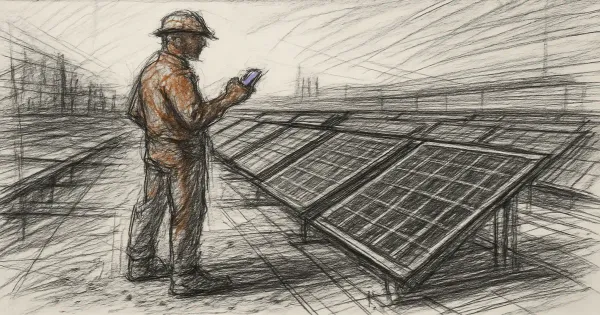
The $500/Day Problem: What Disorganized Jobsites Actually Cost
A breakdown of the hidden daily costs from paper sign-ins, manual reports, scattered photos, and misallocated labor on commercial solar jobsites.
Nobody budgets for chaos. But every commercial solar jobsite pays for it.
I've run enough sites to know where the money goes. It's not the big stuff — not the crane rental or the permit delays. It's the daily friction. The 15 minutes here, the missed cost code there, the report that didn't get filed until someone asked for it three weeks later.
Add it up, and a disorganized jobsite bleeds $300–$500 a day in invisible waste. Here's how.
1. The Sign-In Sheet Nobody Can Read
Paper sign-in sheets are still the norm on most commercial solar sites. A clipboard by the trailer, a pen that may or may not work, and a sheet that gets coffee-stained by 9 AM.
The problem isn't the paper — it's what happens downstream. Someone has to manually transcribe those names into a spreadsheet. Handwriting is illegible. Guys forget to sign in. Sign-out times are fiction. And when payroll needs accurate hours by cost code? Good luck.
Cost: ~$75/day in admin time reconciling sign-in data, plus the occasional payroll dispute that burns an hour of a super's time.
2. The Daily Report Written From Memory
It's 6:30 PM. The super just finished a 10-hour day in the sun. Now they need to write a daily report that accounts for every crew, every activity, weather conditions, safety incidents, materials received, and tomorrow's plan.
Most of the time, this report gets written from memory. Details get missed. Production numbers are estimated. The PM reads it the next morning and has follow-up questions that take another 20 minutes.
Or worse — the report just doesn't get written. It slides to the next day. Then the next. By Friday, you're reconstructing Monday from text messages.
Cost: ~$100/day in supervisor time spent writing, rewriting, and answering questions about reports that should have been generated from real-time data.
3. The Inspection Photos on Someone's Phone
Every inspection generates photos. Racking alignment, torque marks, grounding connections, module placement. These photos are critical for closeout packages and warranty documentation.
Where do they live? On twelve different phones. In camera rolls mixed with personal photos. Maybe someone emailed a few to the project folder. Maybe not.
Six months later, when the client or AHJ asks for documentation of a specific installation area, someone has to dig through phones that may have already been wiped, ask people who may have already moved to the next job, and hope the metadata hasn't been stripped.
Cost: ~$150/day amortized across the project lifecycle, accounting for the closeout scramble, re-inspection costs, and occasional compliance penalties.
4. The Cost Code Guessing Game
Labor allocation by cost code is how you know if you're making money or losing it on a project. But most crews don't track this in real time. Instead, someone at the end of the week estimates what percentage of each worker's hours went to which task.
This creates two problems. First, the numbers are wrong — estimates aren't actuals. Second, the PM can't course-correct during the week because the data is stale. By the time you realize racking is running over budget, you've already burned three extra days of labor.
Cost: ~$125/day in misallocated labor, late cost-code corrections, and the inability to optimize crew deployment in real time.
5. The Safety Doc That Didn't Get Filed
Toolbox talks, pre-task plans, incident reports. Every one needs to be documented, signed, and filed. On most sites, "filed" means "somewhere in a binder in the trailer that nobody has opened since the project started."
An OSHA inspection doesn't care that you did the toolbox talk. It cares that you can prove it. A missing safety document turns a routine inspection into a citation.
Cost: ~$50/day in time spent organizing, locating, and reconstructing safety documentation — and that's before any fines.
The Real Math
Add those up: $75 + $100 + $150 + $125 + $50 = $500/day.
On a 6-month project with 130 working days, that's $65,000 in invisible waste. Not from bad workers or bad management — from bad systems. From trying to run a modern construction project on clipboard-era tools.
The fix isn't more training or more oversight. It's better infrastructure. Digital sign-in that feeds payroll automatically. AI that turns a voice note into a daily report. Photos that tag themselves to the right inspection. Cost codes that track in real time.
That's what I'm building with TradeStack. Not because I read about the problem in a report — because I live it every day.
If you're running commercial solar sites and these numbers feel familiar, try the TradeStack demo or reach out at hello@tradestack.live.